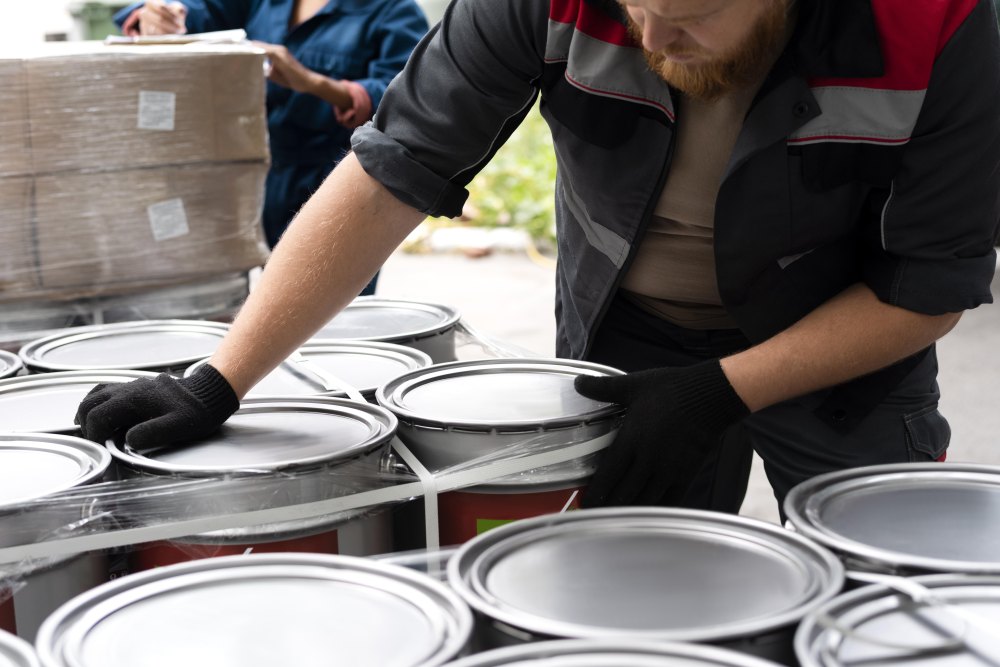
Drum filling is one of those industrial processes that looks straightforward from the outside and reveals its complexity only when something goes wrong, which is precisely why the right equipment and procedures matter as much as they do.
The Industrial Importance of Drum Packaging
Drums are the workhorses of industrial liquid packaging. Chemicals, lubricants, solvents, oils, food-grade liquids, and a range of other industrial substances travel between manufacturers and end users in steel, plastic, and fibre drums of standard sizes – 20 litre, 60 litre, and the ubiquitous 200 to 220 litre standard drum. This standard format simplifies storage, transport, and handling across a global supply chain that assumes drum compatibility at every transfer point.
For the manufacturer filling these drums, the filling process is not a passive step at the end of production. It involves metering the correct quantity of product, maintaining appropriate temperatures for heat-sensitive liquids, complying with chemical handling and safety regulations, and doing all of this at a rate that matches the production line’s output without creating a bottleneck.
Types of Drum Filling Systems
Drum filling systems are available across a wide range of automation levels and filling technologies:
- Gravity filling: uses product weight above the fill head to drive flow. Suitable for thin, low-viscosity liquids. Simple and low-cost but less accurate and slower than pump-based alternatives.
- Pump-based filling: a metering pump delivers a controlled flow rate. More accurate than gravity filling and suitable for a wider range of viscosities.
- Weight-based filling: the drum sits on a load cell platform, and filling stops when the target weight is reached. Provides the highest accuracy and is preferred for high-value products and regulated industries.
- Pressure-based filling: used for certain hazardous or sealed-container applications where the fill head must form a sealed connection with the drum bung before filling.
Safety in Drum Filling Operations
The safety implications of drum filling depend on the product being handled. For flammable solvents, corrosive chemicals, and other hazardous substances, the filling operation must comply with safety regulations governing:
- Earthing and bonding to prevent static discharge that could ignite flammable vapours
- Filling the liquid surface below to minimize splash and vapour generation
- Ventilation of the filling area to prevent vapour accumulation
- Operator PPE requirements for contact with the product or its vapours
- Emergency stop provisions for the filling line
A drum filling system specified for hazardous materials incorporates these safety requirements into the design of the fill head, the control system, and the environmental enclosure.
Efficiency at Scale
In a high-volume drum filling operation, the throughput of the filling line directly determines the production capacity of the facility. A filling system that can process 60 drums per hour versus one limited to 20 per hour represents a threefold difference in output capacity from the same footprint.
Efficiency factors that affect throughput include:
- Fill rate: the volume delivered per unit of time by the filling pump or gravity system
- Drum positioning and capping time: how quickly drums are moved into position, filled, and removed for capping
- Accuracy of each fill: time lost to over-fill correction or under-fill rejection reduces effective throughput
- Changeover time: how long the system takes to transition between different products or drum sizes
“Efficiency is doing things right. Effectiveness is doing the right things. You need both.” – Lee Kuan Yew.
In industrial drum filling, this means the right equipment operated at the right settings for the product and container – not the fastest machine regardless of accuracy.
Integrating Drum Filling with the Broader Packing Line
A drum filling station typically exists within a broader packaging line. It receives product from the manufacturing or blending process upstream, and delivers filled drums to a weighing check station, a capping and sealing machine, and a labelling and palletising system downstream.
The drum filling system must be designed to match the input rate of the upstream process and the handling capacity of the downstream stations. An oversized filling system that fills drums faster than they can be capped and palletised creates an accumulation problem. An undersized one creates an upstream bottleneck.
Supplier Selection for Industrial Drum Filling
Industrial drum filling and packaging equipment suppliers who offer consultation, design, installation, and after-sales service in Singapore provide the most reliable support for manufacturers who depend on continuous filling line uptime. Drum filling solutions specified correctly, installed professionally, and maintained by a local supplier keep industrial packaging operations running safely and efficiently through every production shift.